
To help you assess and monitor the risk profile of your investments, we provide four key risk metrics: Growth %, Liquidity %, Concentration %, and Leverage %. Each of these metrics offers a unique perspective on your portfolio’s exposure to risk and return potential:
Growth Assets
The growth assets % indicates the proportion of your net worth, portfolio, or account allocated to riskier, growth-oriented assets, providing a snapshot of your risk tolerance and investment strategy. Growth assets typically focus on capital appreciation, meaning they aim to increase in value over time but tend to come with higher volatility and risk. These assets include equities, private equity, venture capital, and high-yield bonds, among others. A higher growth % signals a more aggressive investment approach, while a lower growth % suggests a more conservative or defensive stance.
Every holding on the platform is allocated a risk class—either growth or defensive:
- Growth: Higher-risk assets aiming for potential capital gains.
- Defensive: Lower-risk assets focused on capital preservation and income generation.
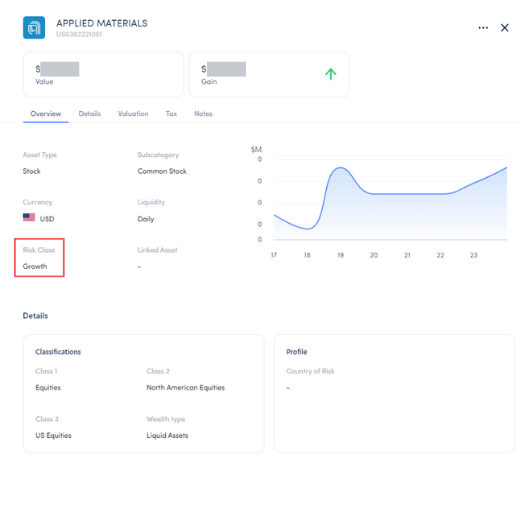
Holdings flowing in from connected investment accounts usually have pre-determined risk classes, although these can be edited to reflect personal preferences or revised views. For private assets, the risk class is suggested when creating the asset, with the option to change based on your own evaluation of the asset's risk profile.
Usually, Asset classes Equities and Alternatives are classified as Growth assets, while Bonds and Cash are classified as Defensive assets.
Growth % = (Sum of all holdings where risk class is 'Growth') ÷ (Total value of portfolio, account, or net worth)
Liquidity
The Liquidity % measures how quickly and easily the assets in your portfolio, account, or total net worth can be converted into cash without significantly affecting their value. It provides insight into the financial flexibility of your investments and how readily you can access funds if needed, either for investment opportunities or unexpected expenses.
Similar to the risk class system, each holding on the platform is assigned a liquidity dimension. This classification helps assess how accessible each asset is, with categories that range from daily, weekly, monthly, quarterly, annually, and illiquid.
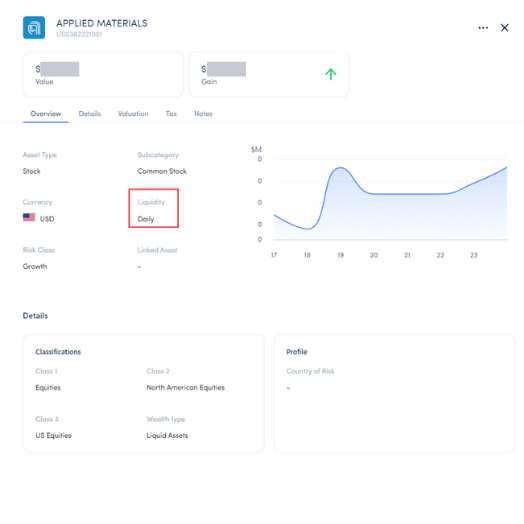
Holdings imported from connected investment accounts are assigned a pre-determined liquidity classification, which can be adjusted if needed. For privately held assets, a liquidity class is assigned during asset creation, with the option to modify it later if necessary.
Typically, asset classes like equities, bonds, and cash are classified as having daily liquidity, while alternative investments can range from daily to illiquid.
Liquidity % = (Sum of all holdings where liquidity is 'Daily', 'Weekly', or 'Monthly') ÷ (Total value of portfolio, account, or net worth)
Concentration
The Concentration % measures the proportion of your total portfolio or account value that is invested in your top five holdings, excluding cash. It provides insight into how concentrated or diversified your portfolio is and the extent to which your portfolio’s performance depends on a few key holdings.
What Does Concentration % Indicate?
-
Portfolio Diversification:
- A high concentration % means a large portion of your portfolio is tied up in a small number of holdings, indicating less diversification.
- A low concentration % implies more diversification, where risk is spread across a larger number of investments.
-
Risk Exposure:
- A higher concentration % suggests more risk, as the portfolio is heavily dependent on the performance of a few assets. If one of these top holdings underperforms, it could significantly impact your portfolio.
- A lower concentration % indicates that risk is more balanced, with no single asset dominating the portfolio’s performance.
Concentration % = (Sum of top five holdings, excluding cash) ÷ (Total portfolio or account value)
Leverage
The Leverage % measures the extent to which your portfolio or account is financed by liabilities (debt) relative to the total value of assets and cash. It provides insight into the level of debt being used to finance your investments and the overall risk associated with your portfolio’s financial structure.
What Does Leverage % Indicate?
-
Debt Utilization:
- A higher leverage % indicates a greater reliance on borrowed funds (liabilities) to finance your investments. This increases potential returns but also heightens risk, as liabilities must be repaid regardless of the performance of the assets.
- A lower leverage % suggests that your portfolio is more self-funded through cash and assets, with less exposure to debt-related risks.
-
Risk Amplification:
- High leverage can amplify both gains and losses. If the assets perform well, the returns on leveraged investments can be significant. However, in the event of poor asset performance, the leverage increases the potential for losses, as liabilities still need to be serviced.
- Low leverage minimizes the risk of financial distress but may limit the potential for higher returns that borrowing can sometimes provide.
Leverage = (Sum of liabilities) ÷ (Total cash + asset value in portfolio or account)